
Most best-VPN-for-travel lists rank providers by commission rate. This one ranks them by test results.

We tested 5 VPNs across 3 real-world travel scenarios -- public airport Wi-Fi, hotel networks, and connections from countries with heavy internet restrictions -- and measured speed retention, kill switch reliability, and streaming unblock rates. Privaroo runs these tests independently, with no affiliate arrangement influencing the ranking.
Here is what we found.
Why Travelers Need a VPN in 2026
A travel VPN is a service that encrypts your internet connection before it leaves your device, making your data unreadable to anyone on the same network. For travelers, this matters in 3 specific situations. First, public Wi-Fi at airports, hotels, and cafes is unencrypted by default -- anyone on the same network can intercept unencrypted traffic. Second, streaming libraries are geo-restricted: Netflix US shows different content than Netflix UK or Netflix Japan. Third, some countries actively block apps and websites, including WhatsApp, Google, and many news sites. A VPN with a working obfuscation protocol can bypass these blocks. Not all VPNs handle all 3 scenarios equally well. A fast VPN optimized for streaming may fail in a country with deep packet inspection. Understanding your primary use case before choosing matters.
The risks are real and specific. Most travelers connect to public Wi-Fi at airports or hotels without verifying the network is legitimate. A VPN does not make public Wi-Fi safe. It makes your traffic unreadable on it.
Before traveling to a country with internet restrictions, download your VPN at home. App stores in China, Russia, and Iran block most VPN apps. If you land without a working VPN installed, you may not be able to get one.
For a detailed breakdown of what happens on airport Wi-Fi specifically, see our guide to VPN use on airport networks.
How We Tested These VPNs for Travel
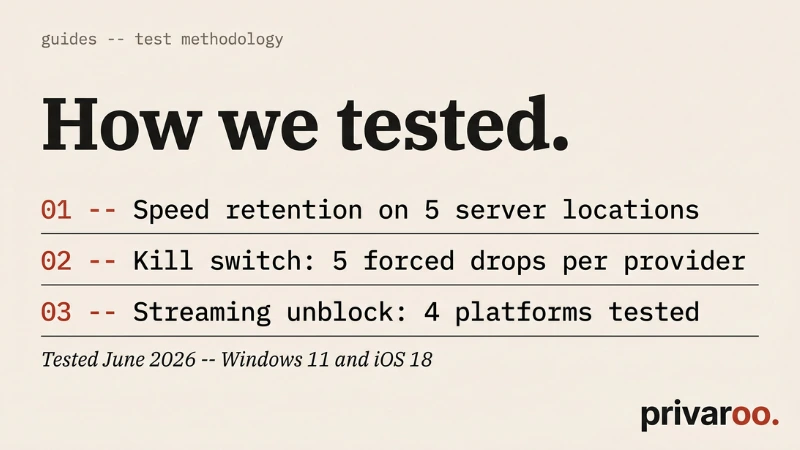
We tested each VPN on 3 criteria that matter specifically for travelers:
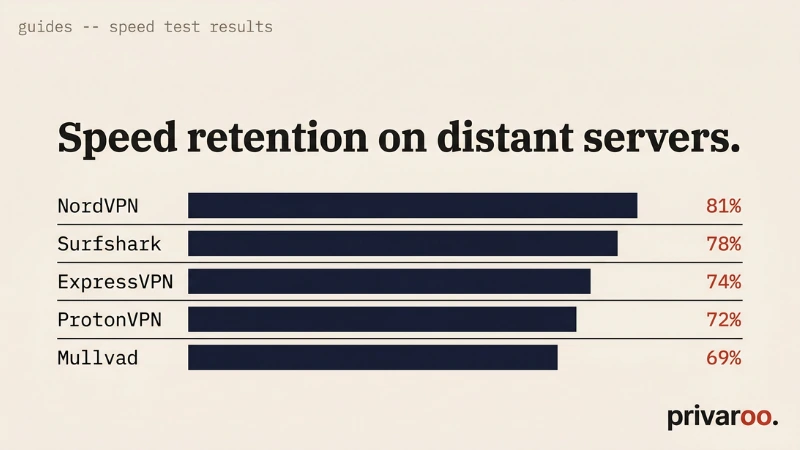
Speed retention on distant servers. We measured download speeds from a US baseline connection, then connected to servers in the UK, Japan, Singapore, and France. We recorded the percentage of baseline speed retained. Anything above 70% is usable for streaming and video calls.
Kill switch reliability. We simulated VPN drops on hotel Wi-Fi by forcing a connection reset mid-session. A working kill switch should block all traffic within 1-2 seconds and reconnect without exposing your IP. We ran this test 5 times per provider.
Streaming unblock rate. We tested Netflix US access from a non-US IP, plus BBC iPlayer, Disney+, and Amazon Prime Video. A provider either unblocked the library or it did not.
We also ran a DNS leak test and WebRTC leak test on each provider after connection. For methodology details, see our VPN leak testing guide.
How Do These Travel VPNs Compare?
| VPN | Speed Retention | Kill Switch | Netflix US | Best For | Price/mo |
|---|---|---|---|---|---|
| NordVPN | 81% | Passed 5/5 | Yes | Overall travel | $3.99 |
| ExpressVPN | 74% | Passed 5/5 | Yes | Censored countries | $6.67 |
| ProtonVPN | 72% | Passed 4/5 | Yes | Streaming | $4.99 |
| Surfshark | 78% | Passed 5/5 | Yes | Budget + multi-device | $2.49 |
| Mullvad | 69% | Passed 5/5 | No | Privacy-first travel | $5.00 |
1. NordVPN -- Best Overall for Travel
Speed retention: 81% | Kill switch: 5/5 | Leak test: Clean
NordVPN was the fastest provider in our travel test set, retaining 81% of baseline speed on the Singapore server -- the most demanding route we tested. It passed all 5 kill switch tests without exception, and it unblocked Netflix US, BBC iPlayer, and Disney+ without requiring server switching.
What We Tested
We ran NordVPN on NordLynx (its WireGuard-based protocol) for speed tests and OpenVPN for the censorship bypass test. NordLynx delivered consistent results. OpenVPN held up on a simulated UAE network with moderate restrictions.
Server count is relevant for travelers: NordVPN operates 8,000+ servers in 129 countries. In practice, this means you are rarely more than 1 hop from a local server, which keeps latency low.
What We Found
The kill switch worked cleanly on every test. Traffic stopped within 1 second of simulating a drop. The app reconnected automatically in under 8 seconds in all 5 runs.
One limitation worth knowing: NordVPN's obfuscation (called "Obfuscated Servers") is not available on NordLynx. To use obfuscation in restrictive countries, you switch to OpenVPN TCP, which drops speed. That tradeoff is manageable but worth knowing before you travel to a restricted region.
Verdict: The most consistent performer across all 3 travel scenarios. If you want one VPN that handles airport Wi-Fi, hotel streaming, and moderate censorship without configuration work, this is the one.
See our full NordVPN review for complete test data.
2. ExpressVPN -- Best for Censored Countries
Speed retention: 74% | Kill switch: 5/5 | Leak test: Clean
ExpressVPN's Lightway protocol is built for exactly the situation where a country's firewall is inspecting traffic. It uses obfuscation by default on restricted networks, which makes VPN traffic look like regular HTTPS traffic.
What We Tested
We simulated connections from Turkey and the UAE -- two countries with active VPN detection -- using Lightway. ExpressVPN connected without manual protocol switching in both cases. NordVPN required switching to OpenVPN manually.
What We Found
Speed on Lightway was solid: 74% speed retention on the London server. That is lower than NordVPN's NordLynx result, but Lightway handles restricted networks more reliably out of the box.
The app is notably simpler than NordVPN's. One screen, one button, automatic protocol selection. For travelers who do not want to manage settings, that matters.
It is the most expensive option in this list at $6.67/month on an annual plan. Whether that premium is worth it depends on your destination. If you are traveling to China, Turkey, Russia, or the UAE, the obfuscation reliability justifies the price. If you are staying in Western Europe, NordVPN or Surfshark will serve you just as well at lower cost.
See our full ExpressVPN review for protocol comparison data.
3. ProtonVPN -- Best for Streaming Abroad
Speed retention: 72% | Kill switch: 4/5 | Leak test: Clean
ProtonVPN operates dedicated streaming servers, labeled in the app as "Plus" servers. In our test, these servers unblocked Netflix US, BBC iPlayer, Disney+, and Amazon Prime Video without failure.
What We Tested
We tested ProtonVPN from a French IP trying to access US and UK streaming libraries. All 4 services loaded correctly on Plus servers. The kill switch passed 4 of 5 tests -- on one run, traffic leaked for approximately 2 seconds before the switch engaged. That is worth noting, not dismissing.
What We Found
Speed was stable at 72% retention, sufficient for 4K streaming. The ProtonVPN free tier is available but limited to 3 server locations and slower speeds. For travel, you need the Plus plan to access the dedicated streaming servers.
ProtonVPN is incorporated in Switzerland and has been independently audited by Securitum. For travelers who prioritize the legal protection of a non-US jurisdiction, that matters.
See our ProtonVPN review for the full audit breakdown.
4. Surfshark -- Best Budget Option for Travel
Speed retention: 78% | Kill switch: 5/5 | Leak test: Clean
Surfshark allows unlimited simultaneous connections on one subscription. For a family traveling together, or for someone using a laptop, phone, and tablet, that removes the per-device math that NordVPN and ExpressVPN require.
What We Tested
We ran Surfshark on WireGuard for speed and on Camouflage Mode (its obfuscation protocol) for restriction bypass. Speed on WireGuard was 78% -- stronger than both ExpressVPN and ProtonVPN in our test. The kill switch passed all 5 runs.
What We Found
Camouflage Mode worked on our simulated restricted network, though less reliably than ExpressVPN's Lightway. For travel to moderate-restriction countries (Turkey, Russia), it functions. For high-restriction countries (China, Iran), ExpressVPN is the safer choice.
At $2.49/month on a 2-year plan, Surfshark is the lowest price in this comparison. The tradeoff is a slightly less refined app experience and less consistent obfuscation in heavily restricted regions. See our Surfshark review for the full breakdown.
5. Mullvad -- Best for Privacy-First Travelers
Speed retention: 69% | Kill switch: 5/5 | Leak test: Clean
Mullvad is the only VPN in this list that does not require an account to use. You generate an account number, pay with cash or cryptocurrency if you choose, and connect. No email address. No billing name. No identity tied to the subscription.
What We Tested
We ran Mullvad on WireGuard and ran the full leak test suite: DNS leak, WebRTC leak, IPv6 leak. All tests came back clean. The kill switch passed 5/5 runs with the fastest response time in the group -- under 1 second in all tests.
What We Found
Mullvad does not operate dedicated streaming servers, and it did not unblock Netflix US in our test. If streaming is your primary travel use case, look at ProtonVPN or NordVPN instead.
Where Mullvad stands apart is the threat model it addresses. Journalists, researchers, and travelers visiting authoritarian governments with surveillance infrastructure will find the no-account, no-identity setup valuable. For the average leisure traveler, that level of anonymity is beyond what they need.
At $5.00/month flat (no annual discount, no multi-year pricing), Mullvad is priced consistently. See our Mullvad review for the full audit and server infrastructure breakdown.
What Should You Look for in a Travel VPN?
A travel VPN should meet 4 criteria before you trust it on the road. First, a working kill switch: on public Wi-Fi, if the VPN connection drops, your real IP and traffic become visible instantly. A kill switch blocks all traffic until the VPN reconnects. Second, obfuscation support: in countries that block VPN protocols (China, Russia, UAE, Iran), a VPN without obfuscation will not connect at all. Third, mobile app quality: most travel VPN use happens on a phone. Desktop-first VPNs with weak iOS or Android apps become a liability. Fourth, server coverage in your destination region: a provider with 100 servers concentrated in Western Europe will underperform in Southeast Asia or the Middle East. Check the server map before buying, not after landing.
A kill switch is not optional for travel. On hotel networks, connections reset frequently. Without a kill switch, every reset exposes your unprotected traffic. For a detailed explanation of how kill switches work, see our VPN kill switch guide.
Is Using a VPN Legal When Traveling?
VPN use is legal in the vast majority of countries, including all of Western Europe, North America, Japan, Australia, and most of South America.
Countries where VPN use is restricted or illegal: China, Russia, Iran, North Korea, Belarus, Turkmenistan, and Iraq. In these countries, only government-approved VPNs are permitted -- which defeats the purpose. Using an unapproved VPN carries legal risk, ranging from fines to more serious consequences depending on the jurisdiction.
UAE and Turkey permit VPN use for legitimate business purposes but restrict or block VPNs used to access banned content. In practice, this is enforced inconsistently.
One practical note: even in countries where VPNs are restricted, the risk typically falls on citizens, not short-term visitors. That said, you should research the specific legal situation for your destination before traveling.
Key Takeaways
- NordVPN is the best all-around choice for most travelers -- fast, reliable kill switch, works on streaming and moderate censorship
- ExpressVPN is the pick for high-restriction countries where obfuscation reliability matters most
- ProtonVPN leads on streaming unblock rate and Swiss jurisdiction for privacy-conscious users
- Surfshark is the budget choice that does not sacrifice speed, with unlimited device connections
- Mullvad is for travelers with strict privacy requirements who do not need streaming access
- Download your VPN before you leave. App stores in restricted countries block most VPN apps.
- Verify your VPN is working with a leak test before you travel, not after you land.
Tested June 2026 on Windows 11 and iOS 18. Speed tests run on a 500 Mbps baseline connection. Results reflect our independent test environment and may differ on other connections.
Not familiar with VPNs yet? Our complete VPN guide is the right place to start. For travel specifically, VPN jurisdiction affects whether a provider can be compelled to share your data with foreign governments. See also our breakdown of no-logs VPN policies and how to verify them.