Most password manager rankings are sorted by affiliate commission. This one is sorted by security evidence.
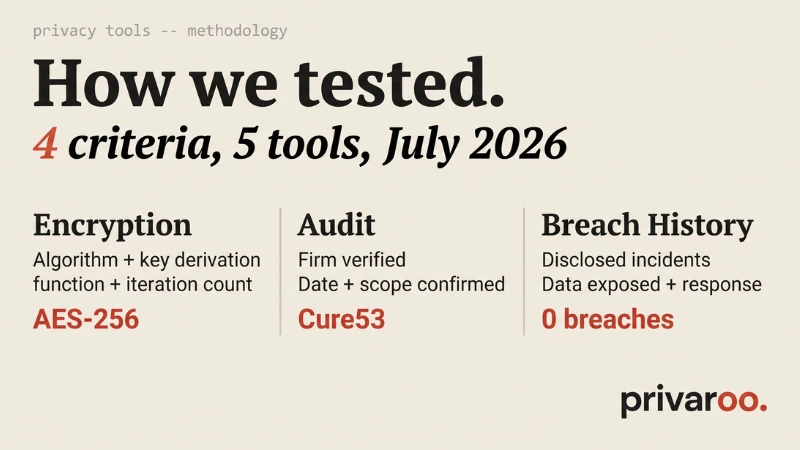
We evaluated 5 password managers on 4 criteria that actually matter: encryption standard and implementation, independent audit status, breach history, and zero-knowledge architecture verification. Privaroo runs these evaluations independently, with no payment from any provider influencing the result.
Here is what we found.
Why Most Password Manager Lists Are Not Trustworthy
The password manager market pays well for affiliate traffic. 1Password, Dashlane, and NordPass all run affiliate programs with commissions between 20-40%. That creates a structural problem: the sites ranking these tools have a financial incentive to rank the highest-paying programs at the top, not the most secure ones.
The result is that most best password manager lists in 2026 look nearly identical, use the same marketing language, and avoid mentioning breach history, audit scope, or encryption implementation details that would actually help you decide.
This list does not work that way. Bitwarden ranks first because it has the strongest combination of open-source transparency, independent auditing, and zero breach history. Not because it pays the most.
How We Evaluated These Password Managers
A zero-knowledge password manager encrypts your vault on your device before it reaches the provider's servers. The provider stores only encrypted data and cannot read your passwords under any circumstance, including when served with a legal request. Verifying this claim requires three checks: reviewing the encryption implementation (algorithm, key derivation function, and iteration count), confirming the provider has been independently audited by a recognized security firm, and checking whether the provider has experienced a breach and what data was exposed. A self-declared zero-knowledge claim with no audit and no public breach disclosure is not verifiable. The four criteria we used: zero-knowledge architecture, independent audit (firm, date, scope), breach history (disclosed or none), and 2FA support (TOTP, hardware key, passkey).
Encryption architecture. We checked the algorithm (AES-256 or XChaCha20), the key derivation function (PBKDF2 or Argon2), and the iteration count. Higher iteration counts slow down brute-force attacks. We also verified whether encryption happens client-side before any data leaves your device.
Independent audit. We checked whether a recognized third-party security firm (Cure53, SOC2, FedRAMP) has audited the provider, when the most recent audit was conducted, and whether any critical findings were disclosed and remediated.
Breach history. We checked whether each provider has experienced a security incident, what data was exposed, and how they disclosed and responded to it. A breach is not automatically disqualifying. How a company responds to one tells you more than the incident itself.
2FA support. We verified support for TOTP authenticator apps, hardware security keys (YubiKey, FIDO2), and passkeys. A password manager with no 2FA support is a single point of failure.
Quick Comparison
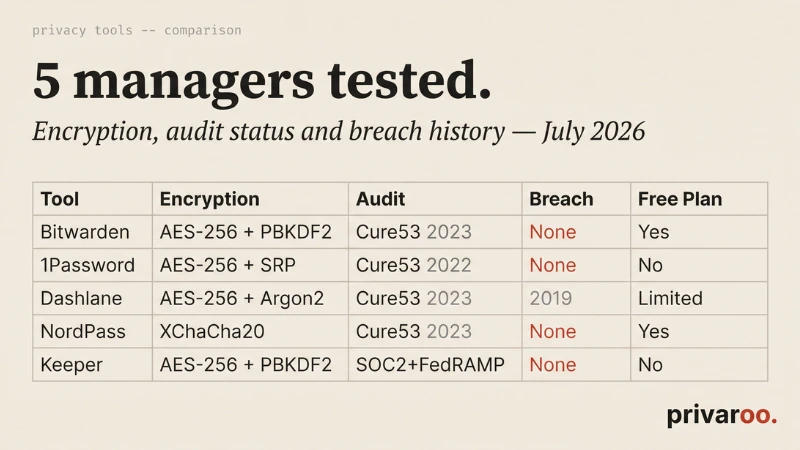
| Password Manager | Encryption | Audit | Breach History | 2FA Support | Free Plan | Price/mo |
|---|---|---|---|---|---|---|
| Bitwarden | AES-256 + PBKDF2 | Cure53 2023 | None | TOTP, YubiKey, FIDO2 | Yes | $1.00 |
| 1Password | AES-256 + SRP | Cure53 2022 | None | TOTP, YubiKey, FIDO2 | No | $2.99 |
| Dashlane | AES-256 + Argon2 | Cure53 2023 | 2019 (no vault data) | TOTP, YubiKey | Limited | $4.99 |
| NordPass | XChaCha20 + Argon2 | Cure53 2023 | None | TOTP, YubiKey, passkeys | Yes (1 device) | $1.49 |
| Keeper | AES-256 + PBKDF2 | SOC2 + FedRAMP | None | TOTP, YubiKey, FIDO2 | No | $2.92 |
1. Bitwarden: Best Overall Password Manager
Encryption: AES-256 + PBKDF2 (600,000 iterations) | Audit: Cure53 2023 | Breach: None | Free: Yes
Bitwarden is the only password manager on this list with fully open-source code. Every line of the client, server, and browser extension is publicly available on GitHub. Any security researcher in the world can audit it independently, at any time, without waiting for a scheduled review.
What We Verified
Bitwarden uses AES-256-CBC encryption with PBKDF2-SHA-256 at 600,000 iterations for key derivation. Your master password never leaves your device. The Cure53 audit in 2023 found no critical vulnerabilities. Bitwarden has never experienced a breach in its history.
The free plan is genuinely unlimited: unlimited passwords, unlimited devices, unlimited syncing. Most competitors artificially limit free plans to push upgrades. Bitwarden does not.
What We Found
2FA support covers TOTP authenticator apps, YubiKey (premium), and FIDO2 hardware keys. The browser extensions work on Chrome, Firefox, Safari, Edge, and Brave. The mobile apps are clean and functional, though less polished visually than 1Password.
The $1.00/month premium plan adds YubiKey support, encrypted file storage, and Bitwarden Authenticator (TOTP built-in). At that price, there is no comparable option.
Verdict: The strongest combination of transparency, audit history, and pricing of any password manager we evaluated. For most users, Bitwarden is the answer.
2. 1Password: Best Security Architecture
Encryption: AES-256 + SRP | Audit: Cure53 2022 | Breach: None | Free: No
1Password has operated for 15 years without a single breach. That is a verifiable record across a period when LastPass (2022), Dashlane (2019), and multiple other managers experienced incidents.
What We Verified
1Password uses a Secret Key architecture: your vault is protected by both your master password and a 128-bit Secret Key generated on your device during setup. Even if 1Password's servers were compromised, an attacker would need your Secret Key to decrypt anything. 1Password itself cannot decrypt your vault.
The Secure Remote Password (SRP) protocol means your master password is never transmitted to 1Password's servers during login, not even in hashed form. The Cure53 audit in 2022 found no critical findings.
What We Found
Travel Mode is a useful feature for privacy-conscious users: hide specific vaults from your device before crossing borders or entering high-risk situations. Watchtower monitors your saved passwords against known breach databases and flags weak, reused, or compromised credentials automatically.
No free plan is the main limitation. At $2.99/month (individual) or $4.99/month (family of 5), it is reasonably priced for what it delivers.
Verdict: The strongest security architecture of any provider in this group. The Secret Key model and 15-year breach-free record are the deciding factors. If you have a family or team, the family plan is the best value at this tier.
See our no-logs VPN policy guide for a parallel explanation of how zero-knowledge architecture works across privacy tools.
3. Dashlane: Best Breach Monitoring
Encryption: AES-256 + Argon2 | Audit: Cure53 2023 | Breach: 2019 (email only) | Free: Limited
In 2019, Dashlane experienced a breach that exposed email addresses and salted, hashed passwords. No vault data was compromised. Dashlane disclosed the incident promptly, forced password resets, and upgraded its key derivation function from PBKDF2 to Argon2 in the aftermath.
What We Verified
Argon2 is the current best-practice key derivation function, winning the Password Hashing Competition in 2015. Dashlane's migration from PBKDF2 to Argon2 post-breach is a concrete security improvement. The Cure53 audit in 2023 found no critical issues.
What We Found
Dashlane's dark web monitoring scans over 12 billion breached records and alerts you in real time if your credentials appear in a new breach. This is the most comprehensive monitoring feature of any provider in this group.
The built-in VPN (powered by Hotspot Shield) is not a replacement for a dedicated VPN. It has data limits, no kill switch verification, and no independent audit. If you need real VPN protection, use a dedicated VPN tested for leaks alongside Dashlane.
At $4.99/month, Dashlane is the most expensive option in this comparison. For most users, Bitwarden at $1.00/month delivers equivalent vault security with better pricing.
Verdict: Best breach monitoring features in this group. Worth the premium if dark web alerting is your priority. Not worth it if you just need secure password storage.
4. NordPass: Best Encryption Standard
Encryption: XChaCha20 + Argon2 | Audit: Cure53 2023 | Breach: None | Free: Yes (1 device)
NordPass uses XChaCha20 encryption instead of AES-256. XChaCha20 is a stream cipher with a 256-bit key that performs better on devices without hardware AES acceleration and has a strong security margin. It is a legitimate and modern choice.
What We Verified
The Cure53 audit in 2023 confirmed the zero-knowledge architecture. Key derivation uses Argon2id, the memory-hard variant that resists GPU-based brute-force attacks. No breach history. Passkey support is fully implemented.
What We Found
The free plan limits you to one active device at a time, which is a real restriction. At $1.49/month on an annual plan, it is close to Bitwarden's pricing with a different encryption approach. If you already use NordVPN, the integrated Nord ecosystem may simplify your privacy stack.
Verdict: The most modern encryption implementation in this group. Best fit for existing NordVPN users who want a consistent provider.
5. Keeper: Best for Compliance and Regulated Industries
Encryption: AES-256 + PBKDF2 | Audit: SOC2 Type 2 + FedRAMP | Breach: None | Free: No
Keeper is the only password manager in this group with FedRAMP authorization, meaning it meets US federal government security requirements for cloud services. If you work in healthcare, finance, or legal, Keeper's compliance record matters.
What We Verified
SOC2 Type 2 certification requires annual third-party audits over a minimum 6-month observation period. FedRAMP authorization requires a more rigorous government-specific security review. Keeper has both. Zero breach history across its operating history.
What We Found
BreachWatch, Keeper's dark web monitoring add-on, costs an additional $2/month on top of the base plan. No free plan. At $2.92/month annually, the compliance certifications are the differentiator.
Verdict: The best option for users who need verifiable compliance documentation. For individuals without regulatory requirements, Bitwarden or 1Password deliver better value.
What Makes a Password Manager Actually Secure
A password manager's security depends on three independently verifiable properties. First, zero-knowledge encryption: the vault must be encrypted client-side using your master password before any data leaves your device, so the provider stores only ciphertext it cannot read. Second, key derivation function: the algorithm that converts your master password into an encryption key must be computationally expensive, making brute-force attacks slow. PBKDF2 at 600,000 iterations and Argon2id are both acceptable in 2026; lower iteration counts are a red flag. Third, independent audit: a security firm must have tested the implementation against the provider's claims and published findings. Open-source code (as in Bitwarden's case) allows continuous community auditing beyond scheduled reviews. A provider that meets all three criteria has a verifiable security posture. One that meets only one or two is making claims you cannot confirm.
Browser built-in password managers (Chrome, Safari) lack independent audits, do not support hardware security keys in most configurations, and tie your password security to your Google or Apple account. They are not a replacement for a dedicated manager.
Enable 2FA on your password manager before anything else. A strong master password with no second factor means a single phishing attack puts your entire vault at risk. Use a TOTP app or a hardware key, not SMS.
For a broader look at how privacy tools work together, see our VPN leak test guide on verifying that your connection is actually protected.
Key Takeaways
- Bitwarden is the best choice for most users: free, open source, Cure53 audited, zero breach history
- 1Password has the best security architecture: Secret Key model, SRP protocol, 15-year breach-free record
- Dashlane has the best breach monitoring: 12 billion records scanned, Argon2 encryption
- NordPass has the best encryption standard: XChaCha20 + Argon2id, full passkey support
- Keeper is best for compliance: SOC2 Type 2 and FedRAMP authorized
- Enable 2FA on your password manager before anything else
- Never use a browser built-in password manager as your only credential store
- Verify your full privacy setup with a leak test
Evaluated July 2026. Encryption specifications verified against provider documentation and independent security research. Breach history sourced from disclosed incident reports.