Almost every VPN on the market claims a strict no-logs policy. Very few of them are telling the full truth.
A no-logs policy is one of the most important - and most misunderstood - features you can look for in a VPN. Understanding what it actually means, what it cannot protect you from, and how to verify a provider's claims before trusting them with your traffic is the difference between real privacy and marketing noise. This guide covers exactly that, based on the testing methodology we use for every VPN reviewed on Privaroo.
What a no-logs VPN policy actually means
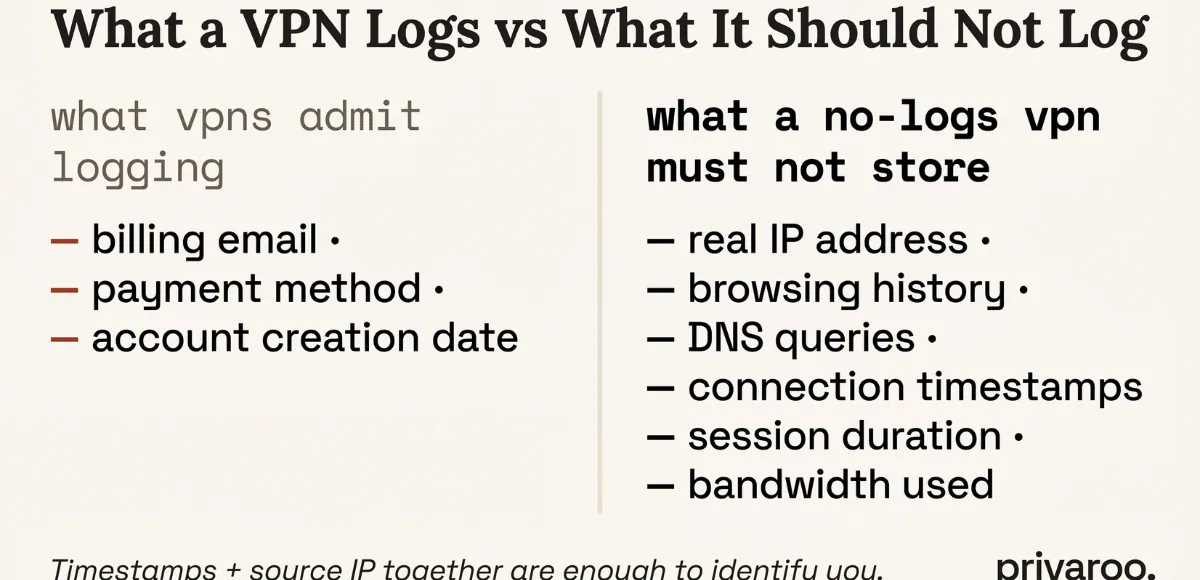
A no-logs VPN policy is a commitment by a VPN provider to store no data that could link a specific user to specific online activity at a specific time. In practice, this means the provider does not record your real IP address, the websites you visit, the files you download, your connection timestamps, or the duration of your sessions.
A genuine no-logs policy means that even if a government or law enforcement agency compels the VPN provider to hand over data, there is nothing to hand over. The key phrase is "nothing to hand over" - not "we would refuse to comply." True no-logs architecture means the data was never stored in the first place, making compliance with a subpoena technically impossible.
Most providers use the phrase "no-logs" loosely. There is a meaningful difference between these three categories:
- No activity logs - no record of what you did online
- No connection logs - no record of when you connected, from which IP, or for how long
- No metadata logs - no anonymized aggregate data that could, under analysis, be tied to individual users
A provider can truthfully claim "we don't log your browsing history" while still recording your connection timestamps and original IP address. Timestamps plus source IP is enough to identify you. That is not a no-logs policy - it is a selective-logs policy with better marketing.
What VPNs can still see even with a genuine no-logs policy
Even a VPN with a verified no-logs policy sees your traffic while it passes through its servers. The policy only governs what the provider stores - not what it observes. This matters because:
- Your VPN provider always knows your real IP - it must, in order to route your traffic back to you. The policy determines whether it logs that IP.
- Your VPN provider sees unencrypted DNS queries - unless it routes DNS through its own resolvers and does not store them.
- Your VPN provider can observe traffic volume and timing - even without storing content, metadata analysis can reveal behavioral patterns.
A no-logs policy is a strong privacy protection against stored data requests (subpoenas, hacks, data breaches). It is not a protection against real-time surveillance, traffic analysis, or a compromised server. For that, you need additional layers - and you can verify your current protection level using our 5-minute VPN leak test.
How no-logs claims are verified: what a VPN audit actually means
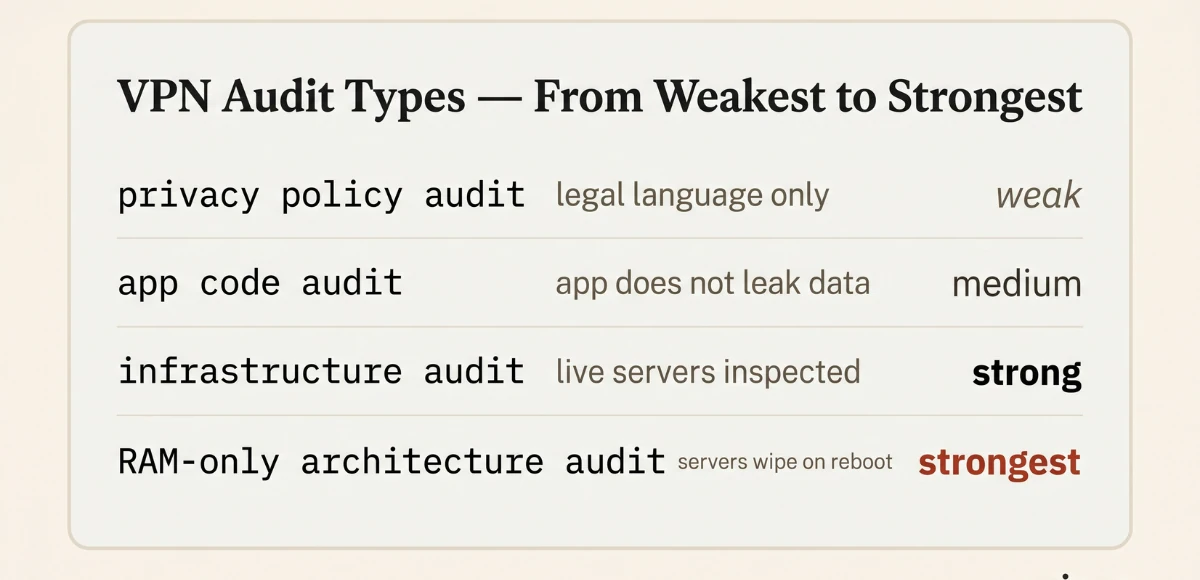
A VPN audit is an independent review conducted by a third-party security firm that examines whether a provider's infrastructure and software actually matches its stated privacy policy. There are two main types: privacy policy audits, which verify that the written policy is legally sound and specific, and infrastructure audits, which involve inspecting live servers to confirm that no logs are being generated or stored.
Infrastructure audits are significantly harder to fake and provide much stronger evidence of a genuine no-logs policy. Providers that have undergone infrastructure audits by recognized firms - including Cure53, Deloitte, and VerSprite - include Mullvad, Proton VPN, and NordVPN. An audit is a point-in-time verification, not a permanent guarantee. Providers should re-audit after major infrastructure changes.
Not all audits are equal. Here is what to look for:
| Audit type | What it verifies | Strength |
|---|---|---|
| Privacy policy audit | Legal language only | Weak |
| App code audit | App does not leak data | Medium |
| Infrastructure audit | Live servers inspected | Strong |
| RAM-only architecture audit | Servers wipe on reboot | Strongest |
When a VPN claims it has been "audited," always ask: audited by whom, for what, and when? A 2019 privacy policy audit conducted by an in-house firm is not meaningful evidence of a genuine no-logs policy in 2026.
VPNs that were caught lying about no-logs
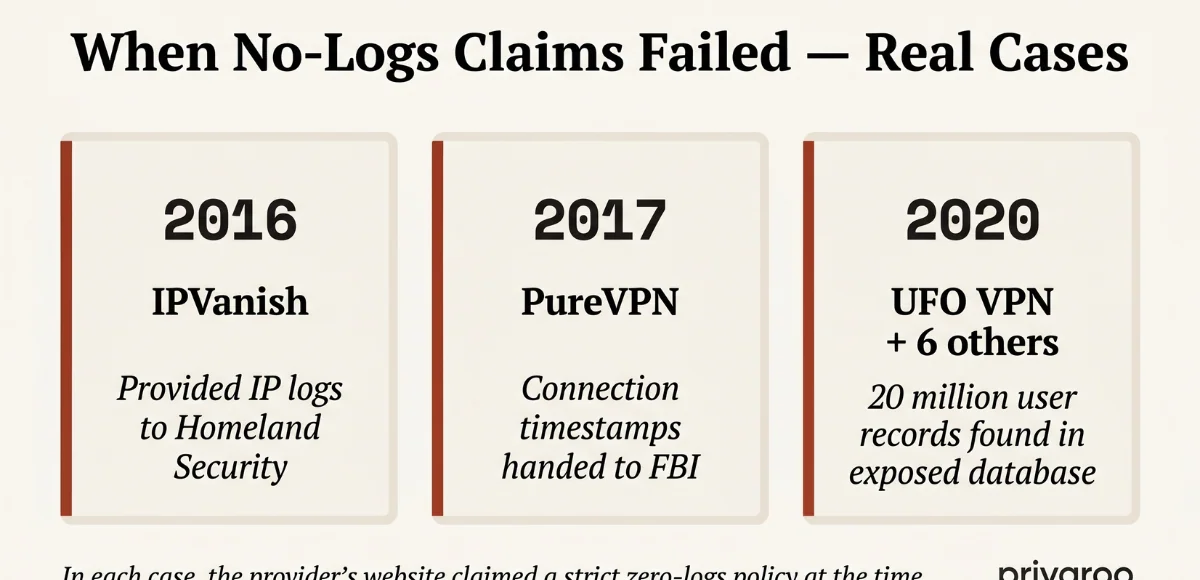
PureVPN (2017) - Marketed as a zero-log VPN. When the FBI investigated a cyberstalking case, PureVPN provided connection timestamps that tied the suspect's home IP address to the VPN IP used in the harassment. The data PureVPN claimed not to store was precise enough to secure a federal conviction (DOJ, 2017).
IPVanish (2016) - Advertised a "strict zero logs policy" on its homepage. When Homeland Security requested records (PCMag, 2016), the company provided logs including source IP addresses and connection timestamps - directly contradicting its public claims.
UFO VPN and six others (2020) - Seven VPN providers, all claiming zero logs, were found to be sharing the same backend infrastructure. A security researcher discovered an exposed database containing over 20 million user records including IP addresses, connection timestamps, and session tokens. These are not edge cases. They are the documented cost of trusting marketing over evidence.
The no-logs VPNs that have actually proven their policy
A small number of providers have demonstrated their no-logs policy either through rigorous independent audits or through real-world legal pressure where no usable data was produced.
Mullvad - Swedish jurisdiction, no email required to sign up, accepts cash. Swedish police executed a search warrant on Mullvad's offices in 2023 and left empty-handed. No customer data was found because none was stored. Their no-logs policy has since been re-verified by a Cure53 infrastructure audit.
ProtonVPN - Swiss jurisdiction, developed by CERN researchers, open-source apps. Multiple Cure53 audits covering both app code and server configuration. Their threat model explicitly accounts for Swiss legal requests, and their privacy policy has been tested by Swiss authorities in unrelated ProtonMail cases.
NordVPN - Panama jurisdiction, infrastructure audited by VerSprite (2022) and Deloitte (2023). NordVPN did experience a server breach in 2018 - but the breach confirmed that no logs were stored, since the attacker obtained nothing usable. For a broader comparison, see our best VPN 2026 guide.
How to read a VPN privacy policy before you trust it
Most users never read a VPN privacy policy. Here are the four questions to answer before trusting one.
1. What data does the provider explicitly say it does NOT collect? Look for a specific list: no IP addresses, no DNS queries, no timestamps, no bandwidth data. Vague language like "we respect your privacy" means nothing.
2. What data does the provider admit it does collect? Billing email, payment method, and account credentials are unavoidable. Anything beyond that - including "anonymized usage statistics" - is a red flag.
3. Where is the provider incorporated, and what are the data retention laws there? Panama, Switzerland, Iceland, and the British Virgin Islands have no mandatory data retention laws. The US, UK, and EU member states do. Jurisdiction determines which government can compel disclosure.
4. Has the privacy policy been verified by an independent infrastructure audit in the last 24 months? If yes, by whom and for what scope? If no, treat the policy as unverified marketing.
Frequently asked questions
Can a VPN with a no-logs policy still be hacked?
Yes. A no-logs policy governs data retention, not server security. If a provider uses RAM-only servers, a breach yields nothing - the server memory wipes on reboot. If a provider uses traditional disk-based servers, a breach could expose configuration files or temporary data even if no long-term logs were stored.
Does a no-logs VPN make you completely anonymous?
No. A no-logs policy eliminates one category of risk: stored data requests. It does not protect against browser fingerprinting, cookie tracking, logged-in accounts, or real-time traffic analysis. Anonymity requires multiple layers.
Is a free VPN ever no-logs?
Rarely. Most free VPN providers monetize through data. ProtonVPN is the only free-tier VPN we recommend - its free plan operates on the same infrastructure and privacy policy as its paid plan, with verified no-logs architecture. See our free vs paid VPN comparison for a full breakdown.
How often should a VPN be re-audited?
After any major infrastructure change and at a minimum every 12-18 months. A 2020 audit is not strong evidence of a 2026 privacy posture. Always check the date and scope of the most recent audit before choosing a provider.