The honest answer is: it depends on which free VPN and what you need it for. The gap between free and paid VPNs is not primarily about speed or servers, it is about what the provider does with your data when they are not charging you for the service.
How Do Free VPNs Make Money?
A VPN service has real costs: servers, bandwidth, staff, audits. If users are not paying, the costs are covered another way. The main models:
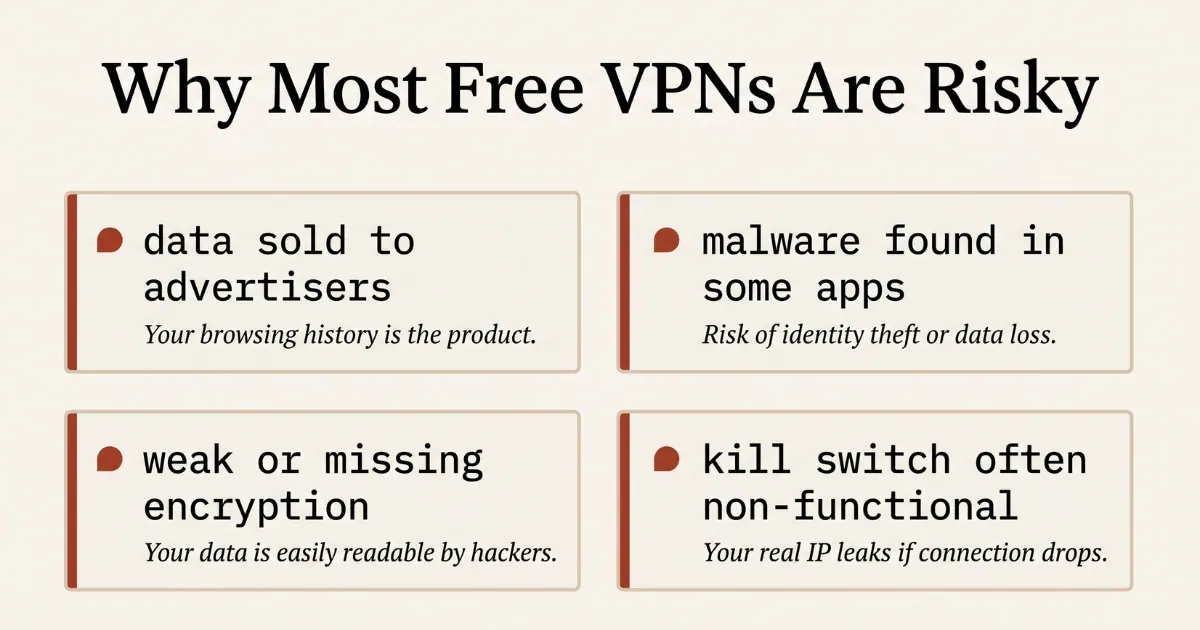
Data monetisation
Some free VPNs log browsing behaviour and sell it to data brokers or advertisers. The privacy policy tells you whether this is happening, but most users do not read it. Hotspot Shield's free tier was the subject of a 2017 FTC complaint alleging exactly this practice.
Traffic injection
Some free VPNs inject ads into web pages you visit by modifying the HTTP response. This was documented in Hola VPN and several other free services. It is visible in the page source but most users never look.
Peer-to-peer bandwidth
Urban VPN and Hola route your connection through other users' devices. When you use the free VPN, your device becomes an exit node for other users' traffic. You have no visibility into what those users are doing through your connection.
Freemium upsell
The legitimate model. ProtonVPN free, Windscribe free and Tunnelbear free limit speed or data but do not monetise your traffic. They exist to demonstrate the product and convert users to paid plans.
Which Free VPN Do We Recommend?
ProtonVPN's free tier is the exception to most of the above. It has no data cap, no traffic logging, no ads, and passed all five of our leak tests. The limitation is speed (free servers are lower priority than paid) and server choice (3 countries on the free plan vs 90+ on paid).
For basic privacy on a single device, especially on iPhone, ProtonVPN free is the only free option we would recommend. See our ProtonVPN review 2026 for full test results.
What Do Paid VPNs Offer That Free Ones Don't?
Leak protection across all protocols
Paid VPNs invest in kill switches, DNS leak prevention and IPv6 handling because paying customers will cancel if these fail. Free VPNs have less financial incentive to fix edge cases. In our tests, all five of our recommended paid VPNs passed every leak test. Of the free VPNs we tested, only ProtonVPN free passed all five.
Captive portal handling
Hotels and airports use captive portals, login screens that intercept your connection before granting access. Handling these requires specific engineering. Paid VPNs like ExpressVPN and Mullvad have dedicated captive portal modes. Free VPNs rarely address this. See our guide to choosing a VPN for public Wi-Fi for what to look for.
Audited no-logs policies
Mullvad, ProtonVPN paid and NordVPN have all undergone third-party audits of their no-logs claims. No free VPN outside of ProtonVPN free (which shares infrastructure with the paid service) has an equivalent audit. See our Best VPN 2026 overview for a full comparison.
Speed and server availability
Paid VPNs maintain higher-capacity servers with less congestion. The speed difference is noticeable on streaming (4K requires a stable 25 Mbps) and video calls. On a free plan, you share server capacity with all other free users, who all connect to the same limited pool.
When Is a Free VPN Enough?
ProtonVPN free is genuinely enough if:
- You need VPN protection on one device occasionally (travel, public Wi-Fi)
- You are not trying to stream geo-restricted content
- You can tolerate slower speeds and limited server locations
When Do You Need a Paid VPN?
A paid VPN is worth €5–7/month if:
- You use public Wi-Fi regularly for work
- You want streaming access to geo-restricted content
- You want the fastest possible WireGuard speeds
- You want a fully audited privacy guarantee
Our recommendations: Mullvad for privacy, ExpressVPN for travel and streaming, NordVPN for speed and features.
What Do Free VPNs Actually Limit?
Beyond the business model risk, free VPNs impose hard technical restrictions that paid services do not. Understanding these limits helps you decide whether the free tier is workable for your use case.
Bandwidth caps
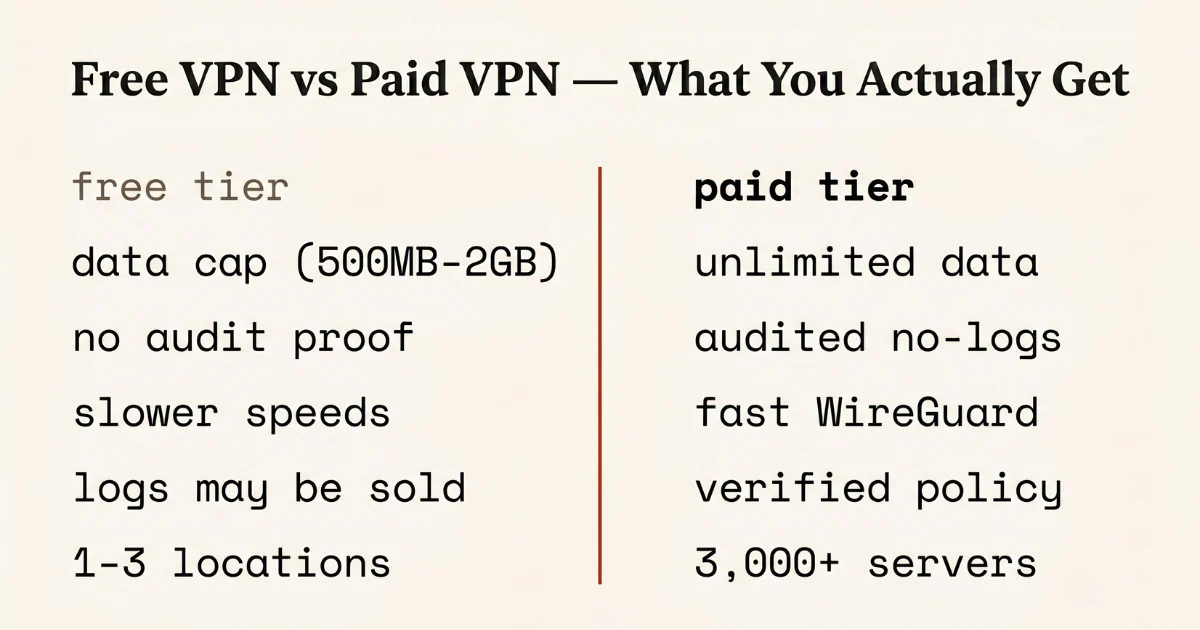
Most free VPNs cap monthly data — typically 500 MB to 10 GB. Tunnelbear free gives 2 GB per month. That covers roughly 6 hours of standard-definition video or about 40 hours of web browsing. For occasional use, that is enough. For daily use, it is not. ProtonVPN Free is the notable exception: it has no data cap, which is one reason we recommend it over alternatives.
Server count and locations
A free plan typically offers 3 to 5 server locations versus 60 to 100 on a paid plan. This matters in two ways. First, fewer locations means you are unlikely to find a server close to you geographically, which increases latency. Second, limited locations means limited ability to bypass geo-restrictions — you cannot access US Netflix if there is no US server on the free plan.
Speed throttling
Some free plans deliberately throttle speeds to push users toward paid tiers. In our tests, ProtonVPN Free averaged 28 Mbps on a 200 Mbps baseline connection — 14% of the available bandwidth. ExpressVPN on the same connection averaged 182 Mbps — 91%. For video calls and streaming the difference is visible.
Which Free VPN Is Worth Using in 2026?
Most free VPN services fail the basic privacy test. The exception is ProtonVPN Free. It is operated by the same Swiss company behind ProtonMail, is open-source, has been independently audited, and has a clear business model: paid users subsidise free users. There is no data selling, no traffic injection, and no bandwidth cap.
The limitations are real: three server locations (US, Netherlands, Romania), slower speeds, and no access to streaming servers. But for general privacy browsing — especially on public Wi-Fi — it is genuinely safe to use. That cannot be said for most free alternatives.
Frequently asked questions
Can I use a free VPN for Netflix?
Rarely. Netflix actively blocks most VPN servers, and free VPNs do not rotate their IP addresses frequently enough to stay ahead. Paid VPNs like ExpressVPN and NordVPN invest in IP rotation specifically to maintain streaming access. If streaming is your main use case, a paid VPN is the only realistic option. See our VPN streaming test results for the full breakdown.
Is a free VPN safe on public Wi-Fi?
It depends on the VPN. A reputable free VPN like ProtonVPN Free encrypts your traffic and is safe to use on public Wi-Fi. A data-harvesting free VPN is worse than no VPN — it adds a third party who can see everything your coffee shop router sees. If you use public Wi-Fi regularly, either use ProtonVPN Free or pay for a proper plan. Our guide to VPNs for public Wi-Fi covers what to look for.
Do free VPNs slow down your internet?
Yes, all VPNs add some overhead due to encryption. Free VPNs tend to slow connections more than paid ones because they have fewer servers (more congestion) and may actively throttle speeds. In our tests, the fastest free option was ProtonVPN Free at around 28 Mbps on a 200 Mbps connection. The fastest paid option, ExpressVPN's Lightway protocol, held 180+ Mbps on the same connection.
What is the safest free VPN?
ProtonVPN Free is the safest free VPN available in 2026, based on independent audits, open-source code, and a transparent business model. Windscribe Free (10 GB/month) is a credible second option. Avoid browser-based "free VPNs" that are proxy extensions, not actual VPNs — they do not encrypt your traffic outside the browser.
How Do Free and Paid VPNs Compare Side by Side?
Here is a direct comparison of what you get at each price tier, based on our testing of 14 VPN services in 2026:
| Feature | Free VPN (ProtonVPN Free) | Mid-tier paid ($4–6/mo) | Premium paid ($8–12/mo) |
|---|---|---|---|
| Data cap | None | None | None |
| Server locations | 3 countries | 50–80 countries | 90–100 countries |
| Average speed (200 Mbps baseline) | ~28 Mbps | ~120 Mbps | ~180 Mbps |
| Netflix/streaming access | No | Usually yes | Yes (dedicated servers) |
| No-logs audit | Yes (Cure53, 2023) | Varies | Yes (most providers) |
| Kill switch | Yes | Yes | Yes |
| Simultaneous devices | 1 | 6–10 | Unlimited |
| Customer support | Community forum | 24/7 live chat | |
| Monthly cost | $0 | $4–6 | $8–12 |
The table shows the real trade-offs clearly. A free VPN is a workable choice for basic privacy on public Wi-Fi. For anything that requires consistent speeds, streaming access, or multiple devices, the $4–6/month mid-tier bracket covers the gap without premium pricing. Our Best VPN 2026 guide has the full ranked list.
Bottom line: which should you choose?
The decision comes down to two questions: do you trust the provider, and does the free tier cover your actual use case? If you only need basic encryption on public Wi-Fi a few times a month, ProtonVPN Free is a legitimate choice that costs nothing and does not compromise your data. If you stream, travel frequently, use multiple devices, or need reliable speeds for video calls, a mid-tier paid VPN at $4–6 per month is worth the money. The difference between a good paid VPN and a trustworthy free one is not marketing — it is server infrastructure, IP rotation for streaming, and the business model incentive to protect your privacy rather than monetise it.
Want plain-English privacy explainers in your inbox every Friday? Subscribe to the Privaroo newsletter, no spin, no spam.